Selling Pantone-Matched Specials When Every Marketplace Only Lists CMYK
Most print marketplaces flatten every job to CMYK. Here's how to sell Pantone spot-colour work, brand matching and specials at proper margins — direct.
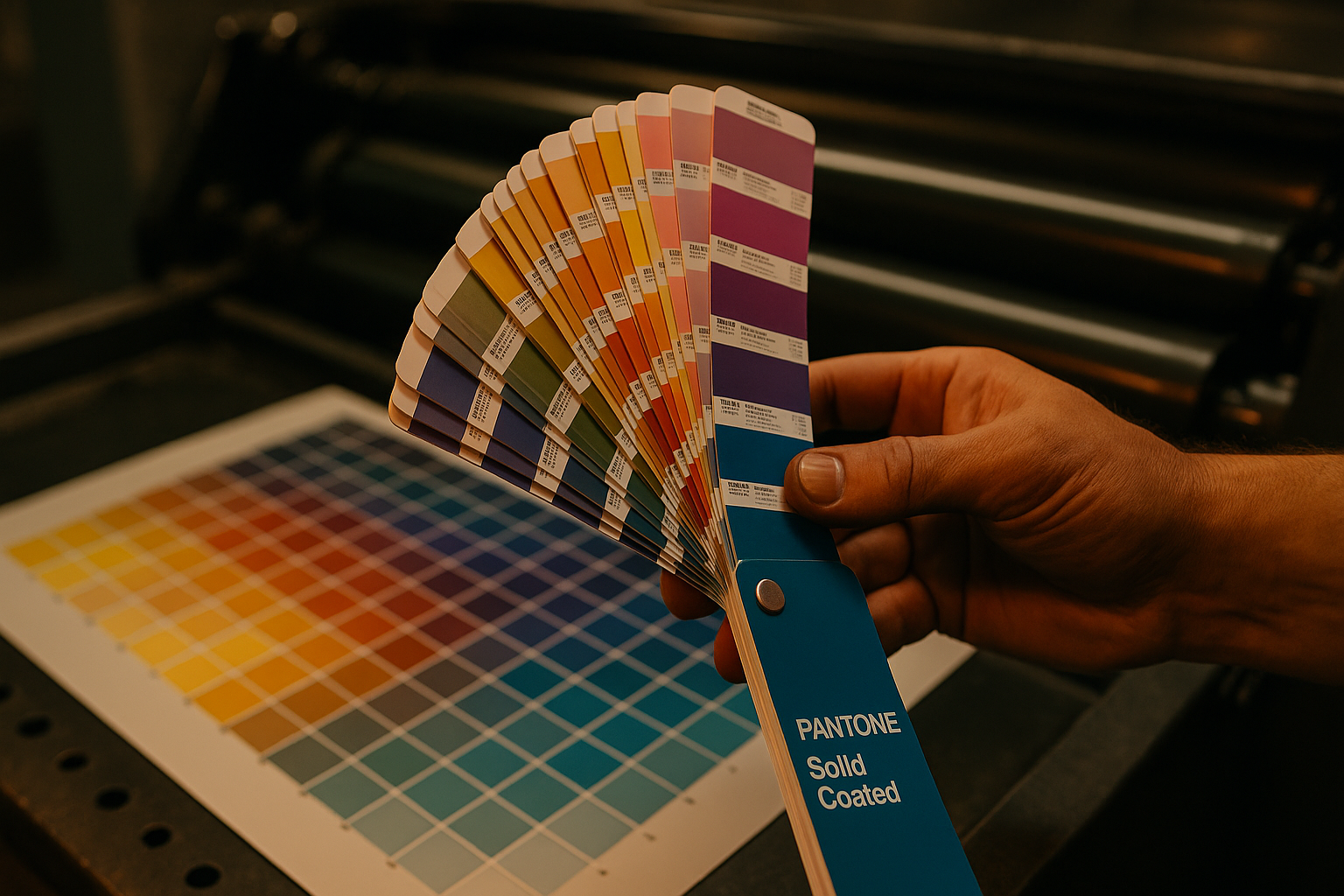
If your press can hold a proper Pantone match — a real spot ink, not a four-colour approximation — you already know the frustration. You log into the big print marketplaces and every drop-down starts and ends with "4/0, 4/4, CMYK digital, CMYK litho." There's nowhere to say I can hit 485 C on uncoated to within a Delta E of 2. And so the work that should be yours ends up quoted as flat CMYK by a shop that can't actually hold the colour.
Why Mainstream Marketplaces Treat Everything As CMYK
Big aggregators optimise for volume, not craft. Their quote engines are built to compare apples to apples across hundreds of shops, so they reduce every job to the lowest common specification: coated or uncoated, GSM, size, quantity, CMYK. Spot colours, fluorescents, metallics, fifth-unit varnishes and Pantone brand matches don't fit neatly into a dropdown, so they simply vanish from the form.
That's fine for a run of business cards. It's a disaster for:
- Brand-critical packaging where the corporate red has to be the corporate red
- Cosmetic and beverage cartons using Pantone metallics or neons
- Membership cards, loyalty schemes and gift vouchers with specific brand equity
- Reprints that have to match an existing physical sample
- Book covers, luxury stationery and any job where the designer specified spot for a reason
The margin that gets left on the table
A CMYK-only marketplace effectively caps your ceiling at the commodity rate. When the buyer can't ask for a spot match, they don't pay for one. And when you can deliver a fifth or sixth unit hit with a Pantone Solid Coated formula guide sitting next to the press, you're being paid the same as a shop running toner. That's not a pricing problem — it's a discovery problem.
Reframing Your Shop Around Colour, Not Just Kit
Most printers list themselves by press: "Heidelberg XL 106, six-colour plus coater." Buyers procuring brand work don't search that way. They search for outcomes — "Pantone match on uncoated," "metallic gold spot," "fluorescent 805 C short run." If your listing and RFQ responses lead with colour capability, you appear in a totally different conversation.
A quick reframing exercise. Write down, in buyer language, what you can actually deliver:
- Which Pantone libraries you routinely mix in-house (Solid Coated, Uncoated, Pastels & Neons, Metallics, Bridge).
- Delta E tolerance you'll commit to, and on which substrates.
- Fifth/sixth unit availability — spot plus varnish, spot plus white on clear, double-hit whites for dark stocks.
- Digital spot simulation capability if you're running an HP Indigo with an extended gamut or a 7-colour Roland — including which Pantones you can actually hit and which you can't.
- Repeatability — can you match a re-order to a previous batch six months later, and how?
That list is your sales pitch. It's also exactly what a packaging buyer, a design studio production manager or a brand-side procurement lead types into a search bar when the commodity marketplaces have failed them.
Using Direct RFQs To Escape The CMYK Trap
This is where a zero-commission model changes the maths. On ZeozGig, a buyer posting an RFQ writes it in their own words — not from a locked template. A designer can say "I need 2,000 folders, 350gsm uncoated, Pantone 2945 C on the outside, black inside, matt lam one side." There is no dropdown squeezing that spec into 4/1 CMYK. You see the actual job, you respond with an actual quote, and you open a direct chat for £5 to nail the finer points — substrate swatch, proof method, brand guideline PDF.
Why fixed fees matter for specials work
Spot-colour and Pantone-matched jobs tend to be lower volume and higher margin. On a percentage-commission marketplace, a marketplace taking 8–15% of a £4,000 packaging run is walking off with £320–£600 of the exact margin you earned by holding tight tolerances at makeready. With a flat £1 to list a capability, £1 to post an RFQ and £5 to open a direct connection, the platform cost on that same job is negligible. Every pound of the premium you charge for proper colour work stays in your business.
And if you post an RFQ yourself — say you're a trade printer sourcing a specialist foil or a Pantone ink mix from another shop — the fee refunds automatically if nobody responds. There's no downside to floating a niche request.
Practical Ways To List Pantone Capability
A few concrete suggestions when you're writing a product or capability listing:
- Put "Pantone spot-colour litho" or "brand colour matching" in the title, not just the body.
- Name the presses and their unit configurations (e.g. Komori Lithrone six-colour plus in-line coater).
- State substrates you've matched on — coated, uncoated, kraft, synthetics, clear films.
- Mention proofing: contract proofs, wet proofs, drawdowns, physical Pantone chip sign-off.
- Flag anything unusual: fluorescents, security inks, thermochromic, tactile spot varnish, foil-plus-Pantone combinations.
Buyers searching for colour-critical work skim for exactly these terms. The more specific you are, the fewer tyre-kickers you'll attract and the higher the conversion on the enquiries you do get.
The Bigger Point
Commodity marketplaces will keep flattening print into CMYK because that's what their business model needs. Your business model doesn't have to play along. There is a growing pool of buyers — packaging brands, design agencies, procurement managers with brand-guideline PDFs on their desks — actively looking for shops that can talk about Delta E, formula guides and fifth-unit whites without flinching.
Meet them where the conversation is actually happening, and price the work for what it's worth.
---
Ready to be found for the colour-critical work you actually want? List your Pantone and spot-colour capability on ZeozGig for £1, or post an RFQ for £1 if you're sourcing a specialist match from another shop — refunded automatically if no one responds. Keep 100% of the margin you earn at the press.