Sourcing Book and Brochure Print at Volume Through Direct Litho RFQs
How print buyers can source high-volume book and brochure litho work through direct RFQs — faster quotes, better margins, no marketplace commission.
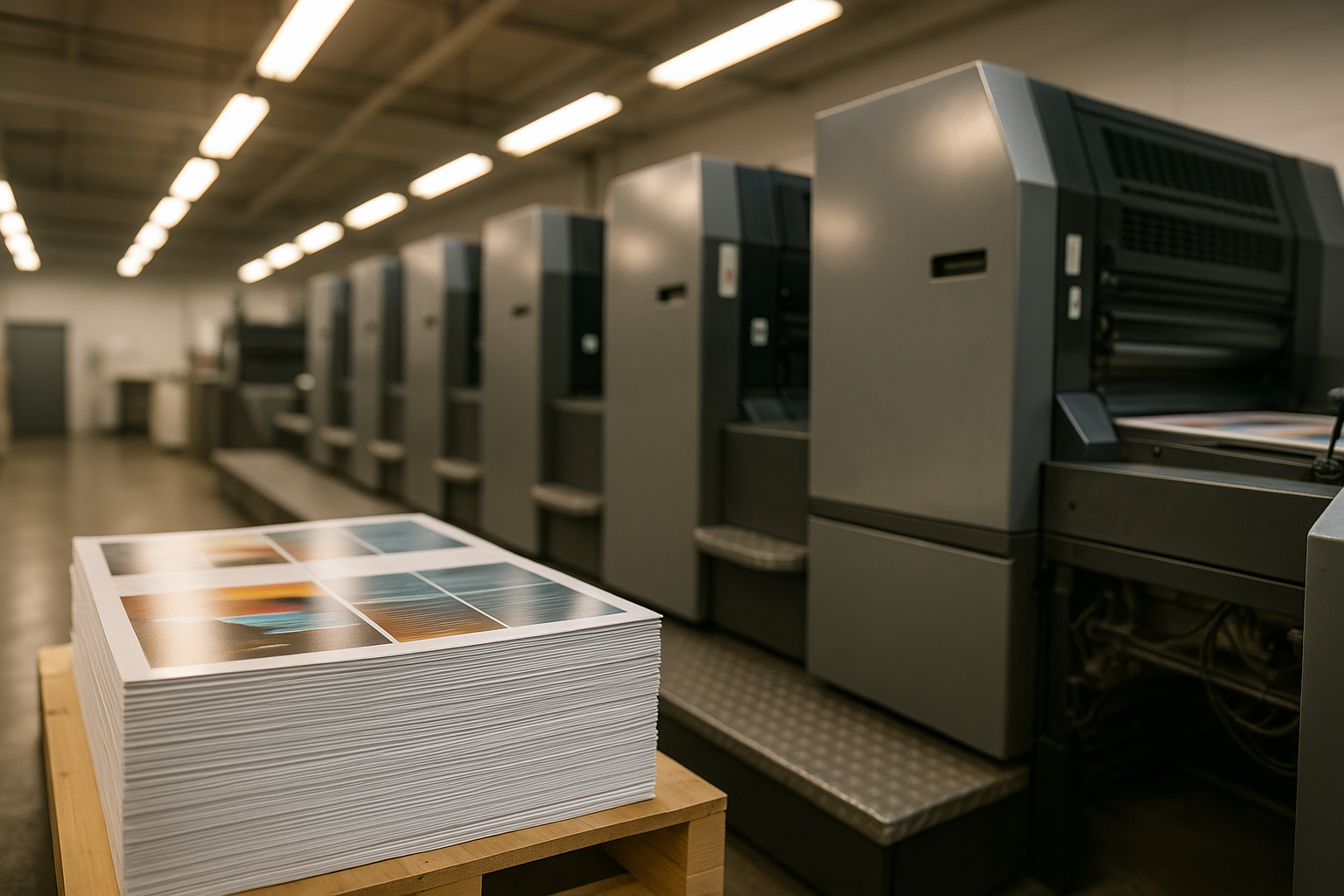
Long-run book and brochure work is the kind of job where every penny per copy matters — and yet most buyers still source it the slow way: emailing three printers they already know, waiting a day for replies, then hoping the numbers stack up against the client price. There is a faster route, and it doesn't involve giving a commission to a middleman.
Why long-run litho deserves a different sourcing approach
Digital print is forgiving. You can shop around casually for a 250-copy booklet and the price won't move dramatically between suppliers. Litho at volume is the opposite. Once you're into the thousands — perpetual bound novels, saddle-stitched brochures, perfect-bound catalogues, case-bound annual reports — the makeready, plate costs, stock choice and press downtime dominate the unit price. A press that's hungry for that exact spec will beat a press that isn't by a wide margin.
That's precisely why phoning your usual two or three trade printers is a weak strategy for volume work. You're not benchmarking. You're guessing.
The hidden cost of a short supplier list
When buyers stick to a familiar rotation, three things tend to happen:
- Quotes cluster around a similar number because the same regional presses share pricing benchmarks.
- Specialist capacity (say, a B1 press sitting idle mid-week) never enters the conversation.
- Unusual stock or bindery requirements get quietly quoted with a safety margin baked in.
None of that is malicious. It's just what happens when a printer doesn't know they're competing against a wider field.
What a direct RFQ actually pulls in
A well-written RFQ for a book or brochure job posted to a marketplace like ZeozGig pulls in quotes from trade litho printers you'd never find through Google, plus the ones you already know. The buyer writes the spec once. Multiple qualified printers see it. Quotes come back inside hours, not days.
For a long-run brochure, a strong RFQ should include:
- Quantity and any run-on rates — e.g. 5,000 copies plus per-1,000 run-on.
- Trim size and orientation — flat and finished.
- Extent — number of pages including covers.
- Stock — GSM, uncoated/silk/gloss, brand if it matters.
- Colours — 4/4 CMYK, or CMYK plus a Pantone special.
- Finishing — saddle-stitched, PUR, section-sewn, laminated cover, spot UV.
- Bleed, artwork format and proof requirement.
- Delivery address, quantity split and deadline.
Get those eight things right and you'll get comparable quotes back. Get them wrong and you'll get eight different versions of "it depends."
Buyers this works for
This approach isn't only for print brokers and print management companies. It suits:
- In-house marketing teams commissioning an annual report or product catalogue.
- Publishers and self-publishers running the first commercial print of a title.
- Charities and membership bodies printing member magazines at volume.
- Event organisers ordering delegate brochures in the thousands.
- Individual authors who've outgrown print-on-demand and want a proper litho run.
On the C2B side, an author sourcing a 3,000-copy paperback run has historically had almost no way to get trade pricing without pretending to be a business. A direct RFQ removes that barrier.
Comparing quotes without getting fooled by the headline number
Once the quotes are in, the temptation is to sort by unit price and pick the winner. Don't. On volume litho, the lowest headline number often hides one of three things: a lighter stock than you asked for, a longer lead time than you can live with, or a delivery split that doesn't match your distribution.
A more honest comparison looks at:
- Total landed cost including delivery to every address.
- Lead time from artwork approval to delivery.
- Proof stage — wet proof, digital contract proof, or PDF only.
- Reprint policy and how they handle a colour dispute.
- Whether the price holds for a repeat order in 60 or 90 days.
On ZeozGig, once you've narrowed it down, opening a direct connection with the shortlisted printers costs a small fixed fee — five pounds to open the channel, and pennies on voice or video if you want to talk it through. There's no percentage skimmed off the top of the job. Whatever margin sits between the trade price and your client price stays with you.
And if nobody bites?
Occasionally a spec is so specialist — an unusual bind, a difficult stock, a very tight deadline — that no one responds. On ZeozGig, the £1 posting fee for an RFQ that gets zero responses is refunded automatically. You're not out of pocket for trying.
Building a repeatable sourcing habit
The buyers who get the most out of direct RFQs treat them as a habit rather than a last resort. Every long-run job over a certain threshold — pick a number, maybe 2,000 copies or £1,500 — goes out to the marketplace as a matter of course, even if you already have a printer in mind. Over a year, you learn which trade presses are genuinely competitive on which specs, and your usual suppliers start sharpening their pencils because they know you're benchmarking.
That's the quiet win. You're not fighting your printers. You're just making the market visible.
Post the job, keep the margin
If you've got a book, brochure or catalogue run coming up and you're tired of the phone-round-and-hope routine, post the spec on ZeozGig. One RFQ, multiple trade litho printers, direct quotes back, and a small fixed fee to connect with the ones you want to work with. No commission, no contract, no percentage of the deal. Just the quote, the printer, and the margin — all yours.