Sourcing Pantone Specials and Unusual Stocks: How Buyers Find Printers Who Actually Deliver
Pantone specials and unusual stocks trip up most printers. Here's how buyers can find the ones who can actually deliver — without cold calling half the trade.
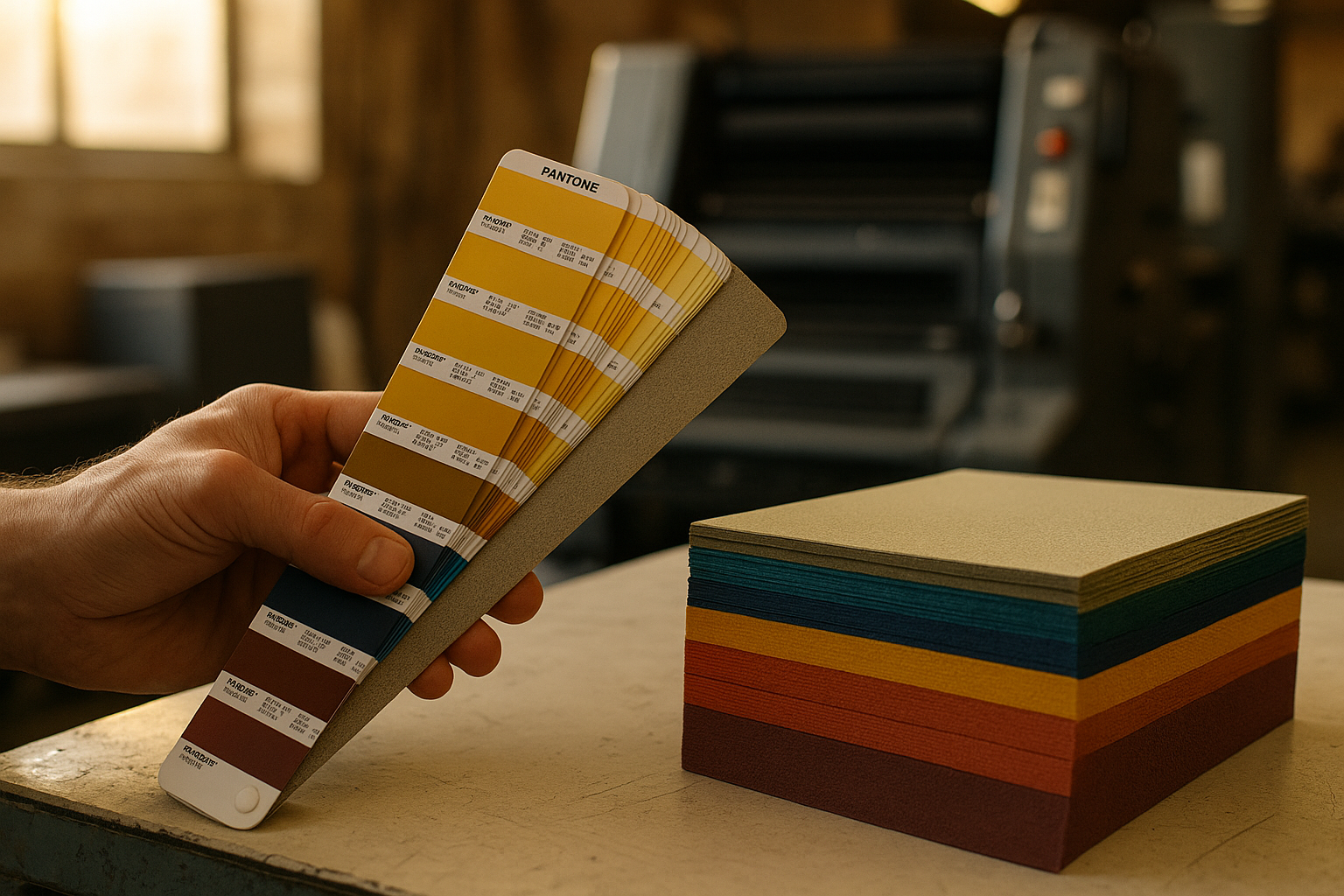
Ask ten printers if they can hit a Pantone 877 metallic on a 350gsm uncoated recycled board with a soft-touch laminate, and you'll get ten confident yeses on the phone — followed by three quiet backouts, two "we can match it close enough" fudges, and one job that arrives looking nothing like the proof. If you've ever briefed a Pantone special or an unusual stock, you already know the problem: everyone says they can do it, until they can't.
Why Pantone Specials and Unusual Stocks Are So Hard to Source
Standard CMYK on a 130gsm silk is a commodity. Almost any digital or litho house in the country will take it. The trouble starts the moment your brief steps outside the middle of the bell curve — a fluorescent Pantone, a metallic, a fifth-unit spot, a GF Smith Colorplan in an odd weight, a translucent, a coloured-through board, a textured cotton, or a specific uncoated shade the client's brand guidelines insist on.
The reasons printers quietly fall over on these jobs are always the same:
- Kit limitations. Not every press has a fifth or sixth unit for a spot colour. Digital presses can approximate a Pantone but rarely nail metallics or fluorescents.
- Stock sourcing. Unusual papers often need to be ordered in by the pallet with lead times measured in weeks, not days.
- Ink mixing. True Pantone matching means mixing to a swatch under a D50 light booth, not eyeballing a build.
- Substrate behaviour. Uncoated, coloured-through and textured stocks absorb ink differently — makeready is longer and waste is higher.
- Finishing compatibility. A soft-touch laminate over a fluorescent will shift the colour. A foil over a textured stock may not key properly.
Any printer can say yes. The ones who can actually deliver have the kit, the stock relationships, and the makeready discipline to prove it.
What a Good Brief Looks Like for a Specialist Job
Before you go looking for a printer, get the brief right. Vague RFQs pull vague quotes, and on specialist work that means nasty surprises at delivery. Whether you're a print broker, an agency producer, or an individual commissioning a one-off wedding invite on Colorplan, include:
- Exact Pantone reference(s) — coated or uncoated book, plus whether a close CMYK build is acceptable as a fallback.
- Stock make, shade and GSM — "Colorplan Adobe Red 270gsm" is useful; "a nice red card" is not.
- Quantity and format — flat size, finished size, bleed, folds.
- Finishing — foil (specify BR, hot or cold), emboss, die-cut, laminate, edge painting.
- Proofing expectations — wet proof, digital contract proof, or press pass.
- Deadline and delivery point.
A tight brief does two things: it filters out the printers who shouldn't be bidding, and it gives the ones who can deliver enough confidence to price sharply.
Why the Marketplace Model Works Better Than Phoning Round
The traditional route for specialist print is a Rolodex — a mental list of three or four trade printers a broker has used before. That works until your usual foiler is full, your Colorplan supplier has gone into administration, or the job needs a capability nobody on your list has.
That's where a two-sided marketplace changes the maths. On ZeozGig, a print buyer posts a single RFQ describing the job — Pantone references, stock, finishing, quantity, deadline — and printers who genuinely have the kit and appetite for it respond with quotes. You're not cold-calling. You're not begging your regular printer to sub it out and add a mark-up. You're pulling multiple trade quotes from suppliers who self-select because they can actually do the work.
How It Plays Out in Practice
- You post the RFQ for £1. If nobody bids, the fee is refunded automatically.
- Interested printers reply with pricing, lead time and often a note on how they'd approach the spot colour or source the stock.
- You pick the one you want to talk to and open a direct connection for a one-off £5 — chat, voice or video.
- From that point on, it's you and the printer. No commission on the job, no percentage taken, no ongoing platform tax. Whatever margin you build in stays with you.
For an agency producer or broker, that means the 15–25% a middleman aggregator would have taken sits in your P&L instead. For an individual commissioning a one-off — an artist doing a foiled print run, a couple ordering letterpress invites, a startup founder ordering die-cut business cards on 540gsm duplex — it means you're paying a printer's price, not a reseller's.
Reading the Responses: Signals a Printer Can Actually Deliver
When quotes come back, the good ones give themselves away. Look for:
- Specific mention of the press and unit configuration ("our Heidelberg XL 106 with a fifth unit for the 877").
- A named paper merchant or in-house stock they hold.
- A realistic lead time — a printer promising a metallic Pantone on unusual stock in 48 hours is either lying or about to disappoint you.
- A note on proofing: wet proof offered, or a clear caveat about digital proof limitations for metallics and fluorescents.
- Willingness to do a press pass for higher-value jobs.
Quotes that are suspiciously cheap, vague on stock, or silent on the spot colour are usually the ones that come unstuck at delivery. Direct chat costs £5 to open — use it to ask two or three sharp questions before you commit.
Post the Job, Let the Right Printers Come to You
Specialist print doesn't need a bigger Rolodex. It needs a wider net and a sharper filter. Post your Pantone-special, unusual-stock or awkward-finishing brief on ZeozGig, let the printers who genuinely have the kit put their hands up, and connect directly with the one you trust — without a commission clipping the deal on the way through. Post your RFQ or list your press capacity today and keep 100% of what you earn.