Letterpress And Craft Printers: Winning Niche RFQs Mass Platforms Ignore
How letterpress and craft print studios can find high-value niche RFQs that generic mass marketplaces route to digital shops instead.
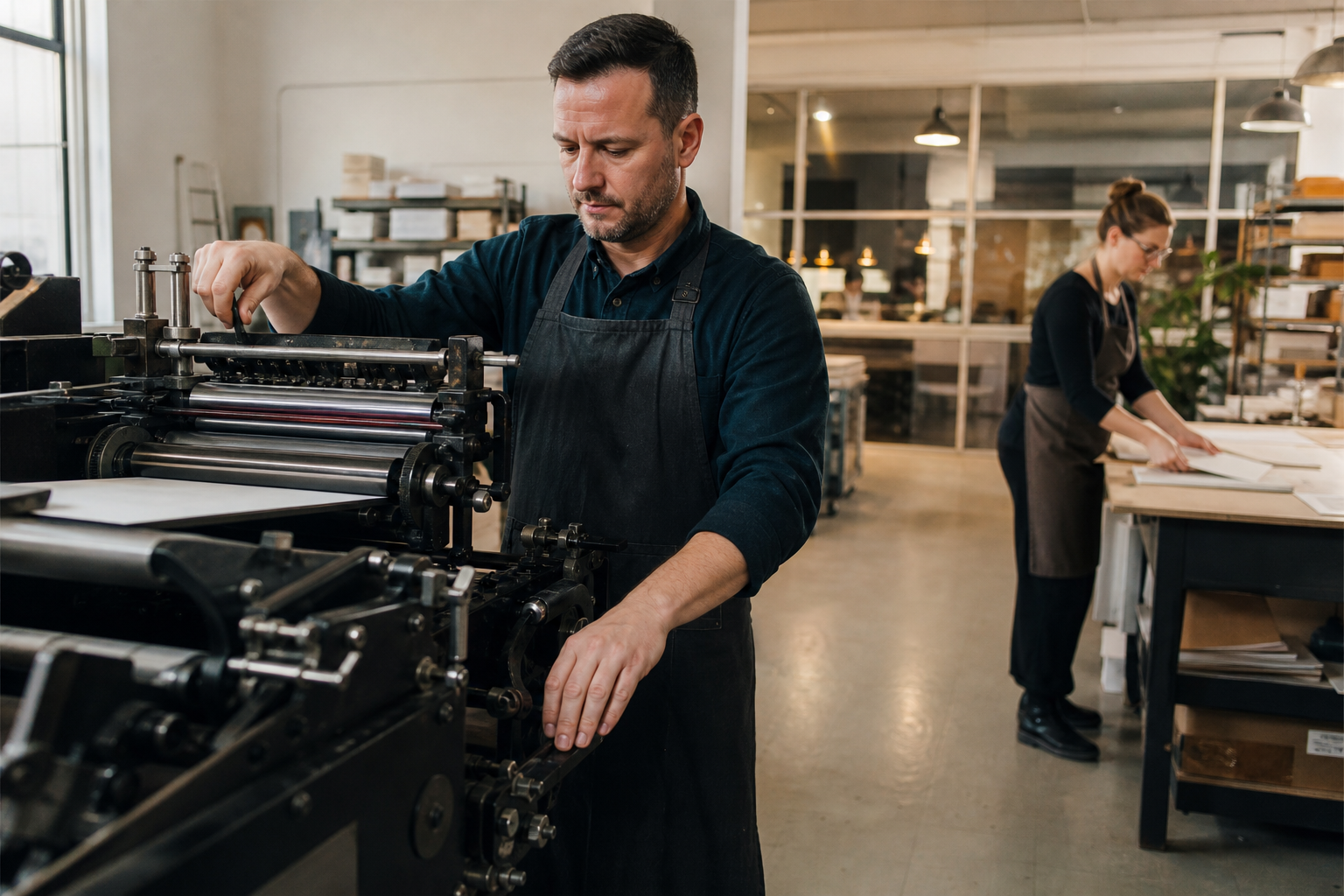
You run a Heidelberg Windmill, a Vandercook proof press, maybe a Chandler & Price treadle in the corner. You mix your own oil-based inks, register two-colour polymer plates by eye, and quote in impressions rather than clicks. And every time someone posts a "letterpress" job on a mass print marketplace, it gets scooped up by a digital shop running 350gsm uncoated through an HP Indigo and calling it "letterpress effect". Sound familiar?
Why Mass Platforms Fail Craft Print Buyers
The big aggregator marketplaces are built for volume and standardisation. Their quote engines assume CMYK digital or four-colour litho on house stock. When a stationer, a luxury brand, or a wedding planner types "letterpress business cards, 600gsm cotton, blind deboss and one Pantone hit" into a generic RFQ form, the platform's algorithm either flattens the spec to something it can price automatically, or fans it out to 40 printers who ignore anything they can't run on a B2 press.
The result: the buyer gets five quotes for digital cards with a raised-ink varnish, none of which are what they asked for. The craft printer never sees the job. And the platform still takes its commission on whatever mismatched deal closes.
The Buyer Profile You're Missing
The people commissioning genuine craft print work aren't shopping on price alone. They're typically:
- Independent stationery designers building wedding suites and event collateral
- Luxury brand agencies producing invitations, launch cards and packaging inserts
- Small-batch spirits, perfume and cosmetics brands wanting tactile labels
- Art directors sourcing exhibition prints, chapbooks and limited-edition runs
- Restaurateurs and hoteliers commissioning menus, coasters and welcome cards
- Independent authors and small presses printing dust jackets, endpapers or covers
These buyers care about deckle edges, cotton and hemp stocks, tonal blind impressions, edge painting, hand-torn deckles and duplex mounting. They understand the price premium — they just need to reach printers who actually offer those services without wading through digital-shop noise.
What A Craft-Friendly RFQ Actually Looks Like
On a marketplace built for direct connections rather than algorithmic matching, a craft RFQ can carry the detail it needs. A typical brief might specify:
- Stock: 600gsm cotton, duplexed to 1200gsm, natural white
- Process: Letterpress, two hits — one Pantone 純 black, one blind deboss
- Registration tolerance: Hand-fed acceptable, +/- 0.5mm
- Finishing: Edge paint in metallic copper, rounded corners at 3mm radius
- Quantity: 250 pairs, delivered flat to a London postcode
- Deadline: Four weeks, artwork supplied as press-ready PDF with separated layers
A digital shop reads that and closes the tab. A craft printer reads it and starts costing polymer plates and makeready. The whole point is to filter — you want the jobs a mass platform would strip out of the spec.
Why Fixed-Fee, Zero-Commission Marketplaces Suit Craft Work
Craft print jobs are often lower quantity and higher margin than commercial runs. A 200-piece letterpress invitation suite might carry the same margin as a 10,000-run digital job — but the commission a percentage-based platform would take is punishing on a bespoke unit price.
This is where a platform like ZeozGig fits naturally. You pay $1 to list a service, $1 to post an RFQ, and $5 to open a direct connection with a buyer or supplier. There's no cut taken from the invoice, no scaling fee that penalises you for pricing your craft properly, and no obligation to run at the margins of a commodity trade printer. Post a job that gets no responses and the fee is refunded automatically — useful when you're testing whether there's demand for, say, a run of edge-gilded tarot decks.
Listing Your Studio So The Right Buyers Find You
If you're a craft printer publishing a listing, resist the temptation to write it like a generic print shop. Lead with what makes you unlikely to be replaced by an Indigo:
- Name your presses explicitly — Windmill, Vandercook SP-15, Adana 8x5
- List maximum sheet size and impression area
- Specify the stocks you regularly hold (Colorplan, Gmund Cotton, Crane's Lettra, Somerset)
- Note the finishing you offer in-house: edge painting, gilding, hand-tearing, letterpress-and-foil combos
- Include turnaround honestly — hand-fed work isn't next-day
- Flag any speciality: numbered editions, hot-foil, thermography, blind emboss
Specificity attracts specificity. A designer searching for "Colorplan 540gsm two-colour letterpress" is a warm lead in a way that "business cards London" never will be.
Overflow And Collaboration Between Craft Studios
The craft print community is small enough that overflow work between studios is common. If your Windmill is booked out but a stationer needs a rush job, you'd rather refer the work to a peer than lose the client entirely. Direct-connection marketplaces make that referral traceable and cheap — a $5 connection fee to introduce a fellow letterpress studio to your overflow client beats losing the relationship altogether, and there's no platform sitting between you skimming the invoice.
Ready To Reach Buyers Who Actually Want Craft Print?
If you've spent years watching mass platforms strip the craft out of every brief, it's worth trying a channel built the other way round. List your presses, stocks and finishing on ZeozGig for a pound, post an RFQ for the kit or paper you need, and connect directly with buyers who understand the difference between deboss and digital. Keep 100% of what you earn — and finally get quoted the jobs your studio was built for.