Turning Press Downtime Into Revenue: Listing Spare Capacity As A Sellable Product
Idle shifts on your litho or digital press are a sunk cost. Here's how to turn press downtime into a sellable product line on a zero-commission marketplace.
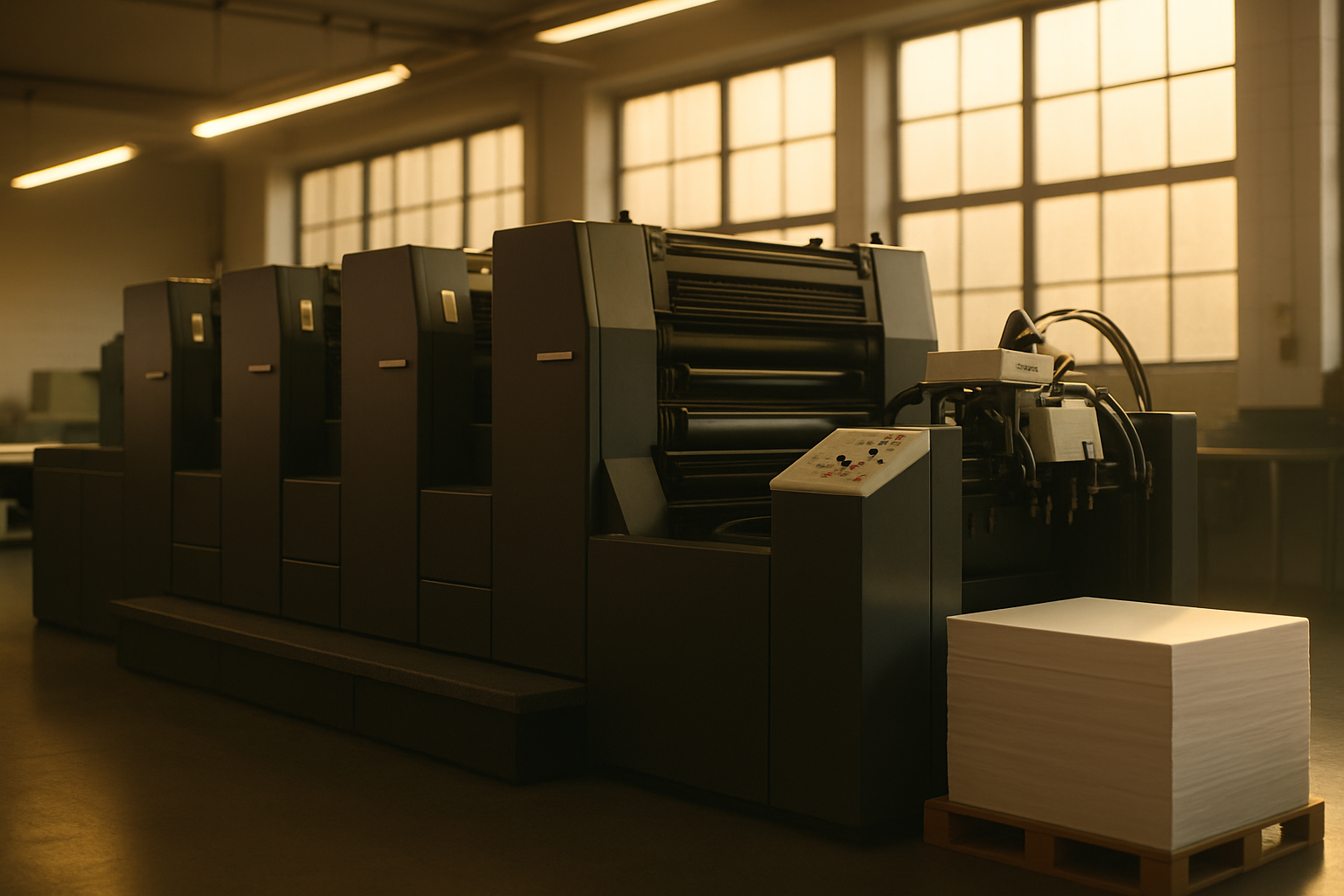
Every print MD knows the feeling: it's Tuesday afternoon, the B2 litho is sitting idle until Thursday's makeready, the night shift on the digital is light, and the wide-format has a four-hour gap before the next roll goes on. That capacity is money walking out the door — and most printers never put it on the market in any structured way.
Why Idle Capacity Is The Most Expensive Thing In Your Shop
A press doesn't stop costing you money when it stops running. Depreciation, finance, rent, heat, light, and salaried operators all keep ticking. Industry benchmarks put true productive utilisation on commercial litho somewhere between 35% and 55% of available hours — meaning roughly half the cost base of your most expensive asset is being absorbed by jobs that aren't there.
The usual fix is to chase more direct work, which means more sales effort, more estimating, and more competing with online quote engines that have already trained buyers to expect commodity pricing. There's a quieter alternative: sell the gap itself, as a product, to other printers and brokers who need overflow.
Trade Work Is The Most Underused Lever
Trade printing has always existed, but it tends to live in a handful of long-standing relationships — the same three trade partners you've been ringing for a decade. The market is much larger than that, and most of it is invisible because nobody publishes their open slots. Brokers, agencies and smaller printers are constantly searching for:
- Litho B1 or B2 capacity for runs above 5,000 sheets
- HP Indigo or dry-toner digital slots for short-run colour
- Wide-format roll time for roll-up banners, PVC and fabric
- Finishing windows — folding, perfect binding, saddle-stitch, foiling
- Overnight or weekend shifts where your fixed costs are already paid
If none of that is listed anywhere a buyer can search, none of it gets sold.
Treating Spare Capacity As A Listable Product
The mental shift is to stop thinking of trade work as a favour you do between "real" jobs and start thinking of it as a product line with its own SKU, pricing and availability. On ZeozGig, that means a permanent marketplace listing for each capability you want to fill — not a one-off RFQ response.
A good capacity listing reads less like a press spec sheet and more like an offer:
- The kit — make, model, max sheet size, GSM range, colours, special features (white ink, fifth unit, in-line coating).
- The window — typical lead time, turnaround on standard stocks, cut-off times for next-day.
- The sweet spot — run lengths and formats where your pricing is genuinely competitive, not just possible.
- What you'll do for trade — plain wrap, neutral delivery notes, drop-ship to the end client, file prep tolerances, proofing options.
- What you won't do — useful honesty. If you don't want sub-500 digital runs or anything under 150gsm on the litho, say so. It saves everyone's time.
Pricing The Gap, Not The Job
Most printers price every job from a standard hourly rate, which makes trade work look unprofitable. But the marginal cost of running a press that's already staffed and warm is dramatically lower than the fully-loaded rate. A separate trade price list — built around contribution to overhead rather than full cost recovery — turns previously-unprofitable enquiries into welcome ones.
That doesn't mean racing to the bottom. It means recognising that £400 of contribution on an otherwise-empty Wednesday night shift is £400 more than £0.
Why The Marketplace Model Matters Here
The reason capacity listings have historically been thin on the ground is that the commercial model of most print marketplaces actively discourages them. If a platform takes 8–15% of every job, you can't afford to advertise marginal-cost pricing — the commission eats the contribution.
ZeozGig's flat-fee model is built for exactly this kind of transaction:
- £1 to list a capability in the permanent marketplace
- £5 one-off when a buyer opens a direct chat
- £0.50 for a voice call, £1 for a video call
- No percentage of the job, ever
- Post an RFQ that gets zero responses and the fee is refunded automatically
That means a £600 overflow run pays you £600 minus your actual production cost, not £600 minus production cost minus a commission slice. Over a year of filled gaps, that's the difference between trade work being a chore and trade work being a serious profit centre.
Visibility Without Salespeople
A permanent listing also works while you're not. A broker in Birmingham searching for B2 litho at 11pm on a Sunday can find your capability, message you directly, and have a quote in their inbox before Monday's first coffee — no commission gatekeeper, no lead-rationing algorithm, no monthly subscription you forgot to cancel.
A Practical Starting Point
If you've never listed capacity formally, start small:
- Pick the one press that has the most painful idle hours.
- Write a single honest listing focused on the run lengths and stocks where you're genuinely strong.
- Build a trade price list for that kit only.
- Track how many connections turn into repeat buyers over 90 days.
Most printers find that two or three regular trade relationships emerge quickly, and those relationships fill the gaps far more reliably than chasing fresh direct work ever did.
Put Your Gaps On The Market
If there's a press in your shop that isn't running tonight, that's a listing waiting to be written. List your capacity on ZeozGig for £1, keep 100% of what you earn, and let the buyers who need exactly what you've got find you directly — no commission, no contracts, no middleman taking a slice of work your kit was always going to do anyway.