Why Regional Signage And Large-Format RFQs Get Lost On National Aggregators
Big print aggregators struggle with regional signage and wide-format jobs. Here's why local context wins — and how direct RFQs change the game.
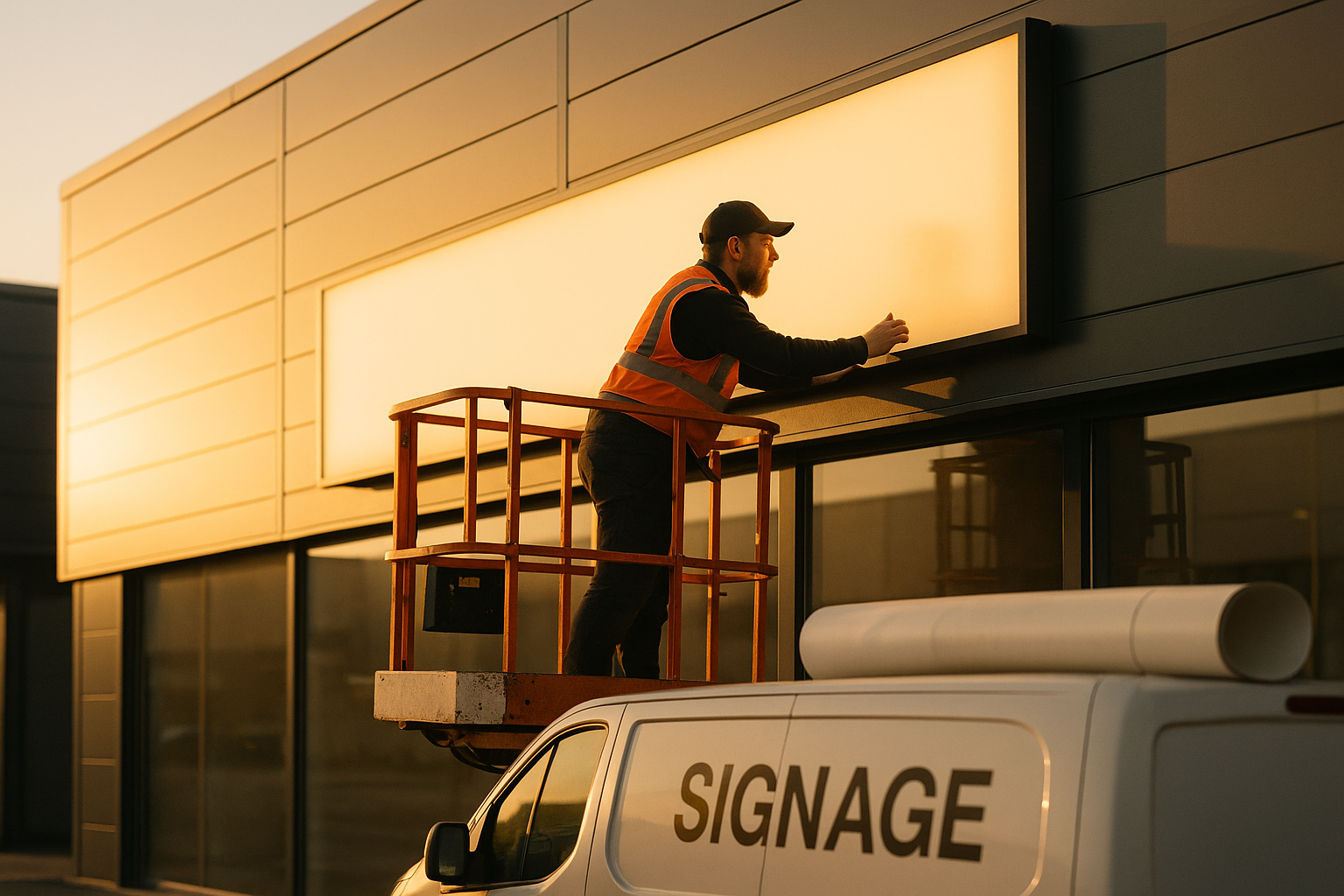
You've seen the brief: 14 pavement signs across three retail parks, install included, two-week turnaround. You quote, you wait, and you lose it to someone who has no idea the council requires planning consent for one of the sites. Regional signage and large-format work is messy, location-specific, and almost impossible to standardise — which is exactly why national aggregators handle it so badly.
The problem with treating signage like a commodity
Most big print marketplaces were built around products that ship in a box: business cards, flyers, booklets. The pricing logic is simple — paper, ink, finishing, postage. Wide-format and signage break that model the second you add site surveys, wayfinding consistency, installation crews, wind-load calculations or a client who needs the wrap fitted before the showroom opens on Saturday.
When an aggregator routes a signage RFQ through its algorithm, it tends to optimise for price-per-square-metre. That's a fine metric for a roll of 440gsm PVC banner — and a terrible one for a job that involves a cherry picker, a TM2 traffic management plan and a client who wants Pantone 286 C matched across illuminated acrylic, dibond and vinyl.
What buyers actually need from a regional supplier
If you talk to facilities managers, shopfitters or marketing leads commissioning signage outside London, the wishlist is remarkably consistent:
- A printer within driving distance of the install site
- Someone who can do a site survey, not just a remote quote
- Knowledge of local permitting, listed building rules or landlord consents
- A finishing setup that handles their substrate of choice (foamex, dibond, acrylic, mesh, magnetic)
- A real human to ring when the install crew hits a snag at 7am
None of that fits neatly into a dropdown menu on a national platform.
Why aggregators struggle with geography
The economics of a commission-based marketplace push toward volume and standardisation. The bigger the platform, the more it needs jobs that can be auto-quoted, batched and shipped from anywhere. Regional signage is the opposite — it rewards proximity, relationships and judgement.
A few specific failure modes show up again and again:
- Quote sprawl — buyers receive ten quotes from suppliers 200 miles away who'll subcontract anyway, adding a margin layer.
- Lost context — the brief gets stripped to dimensions and material, losing the install detail that actually drives cost.
- No direct conversation — messages route through the platform, slowing down the back-and-forth that complex jobs demand.
- Commission baked in — the printer either absorbs 10–20% or pads the quote, and the buyer pays either way.
- Generic supplier matching — a wide-format house in Glasgow gets pinged for a job in Plymouth because the algorithm doesn't weigh travel time properly.
The hidden cost of middlemen on a £4,000 wrap
Let's run the maths quickly. A van wrap quoted at £4,000 on a commission-heavy platform might carry a 12% platform fee — that's £480 gone before the printer pays for cast vinyl, laminate, design time and a two-person install. On a fixed-fee model where the supplier paid a couple of pounds to respond to the RFQ, that £480 stays with the business that did the work. Multiply across a year of jobs and you're looking at a new printer, a recruited installer, or simply a healthier balance sheet.
How direct RFQs change the dynamic for signage
This is where a zero-commission, direct-connection model genuinely shifts things for regional wide-format. On ZeozGig, a buyer posts a signage RFQ for £1 — let's say "6no. illuminated fascia signs, Birmingham city centre, install required, planning drawings available". Local signage companies see it, respond, and if the buyer wants to take a conversation forward they open a direct connection for a fixed £5. From there it's chat, voice or video — no quote routed through a middleman, no commission on the eventual £18,000 order.
If the RFQ gets zero responses (rare, but possible for very niche jobs), the £1 is refunded automatically. That removes the risk of posting unusual briefs — exactly the kind of work aggregators handle worst.
What this looks like in practice
A few scenarios where the direct model genuinely outperforms:
- Multi-site retail rollouts where a buyer wants three regional suppliers covering north, midlands and south, each handling install in their patch.
- Event and exhibition graphics with tight build deadlines where a 20-minute video call beats four days of platform messaging.
- Vehicle livery fleets where the printer needs to see the vans before quoting cast vs calendered vinyl.
- Heritage and listed-building signage where local knowledge of conservation officers is worth more than the lowest price.
- Wayfinding refreshes across hospitals, universities or business parks, where consistency across substrates matters more than headline rate.
Building a regional reputation without paying for it twice
The other quiet win for wide-format suppliers is listing kit and capabilities permanently on the marketplace for £1 per listing. A Roland TrueVIS, a Mimaki UCJV flatbed, a CNC router for dibond cutting, an in-house install team with IPAF tickets — list them once and buyers searching your region find you without you bidding for every job.
Over time that builds a regional presence that doesn't depend on outranking aggregators on Google or paying for every lead. You're discoverable on your actual capabilities, not on how much commission you're willing to surrender.
Ready to put your region on the map?
If you run a signage or large-format shop and you're tired of losing local jobs to distant aggregator picks — or you're a buyer commissioning regional signage and bored of quote sprawl — post your RFQ or list your kit on ZeozGig today. £1 to post, £5 to open a direct line to the supplier you actually want to work with, and zero commission on whatever you build from there.