Subcontracting Wide-Format Jobs Without Handing Over Your Hard-Earned Margin
Practical tactics for print shops subcontracting wide-format work — protect margin, vet trade partners fast, and keep the client relationship yours.
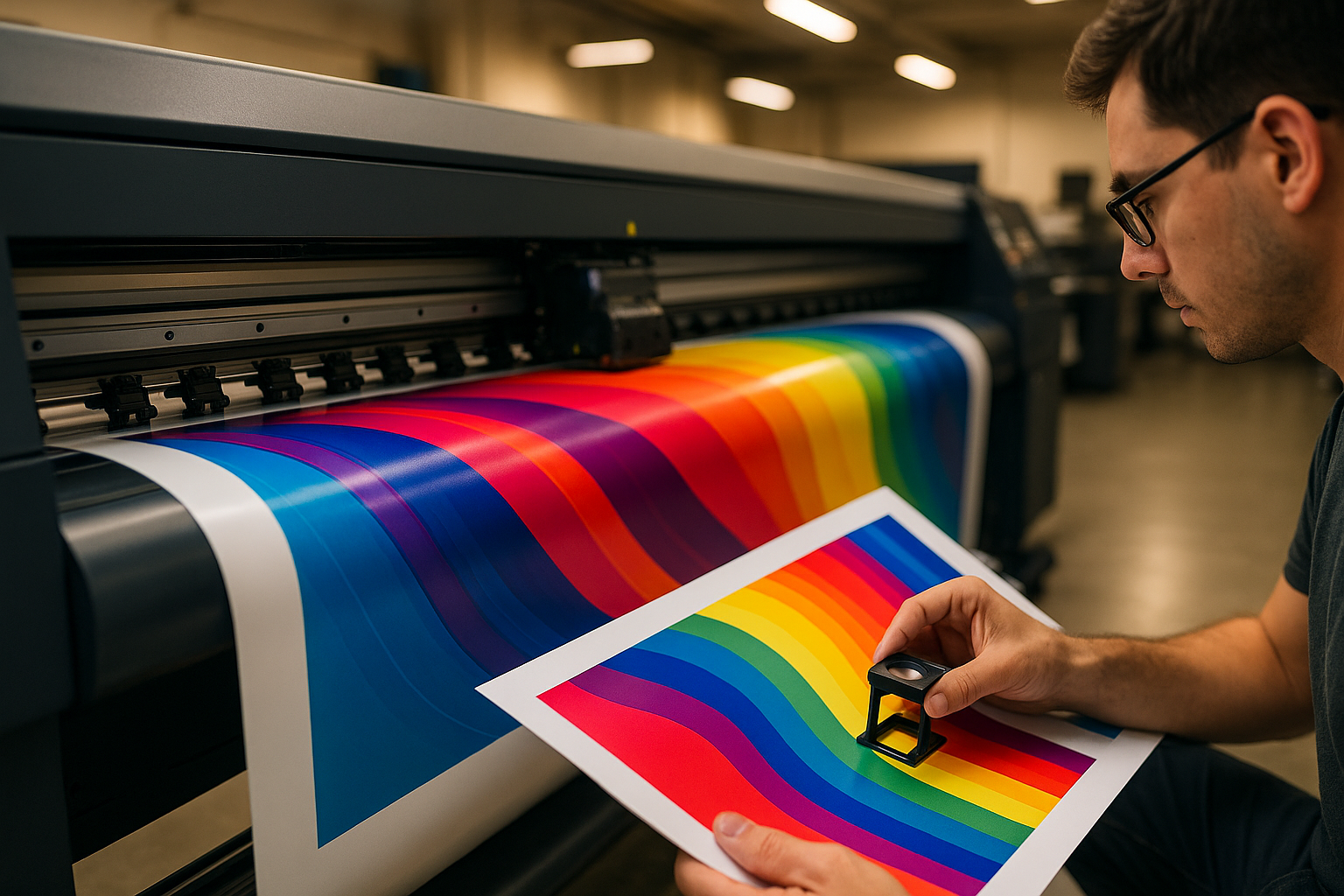
You've won the job — 40 pull-up banners, 12 site hoardings and a set of window graphics — but your 1.6m eco-solvent is booked solid for a fortnight. Now you're scrambling for a trade partner who won't quietly pocket half your margin or, worse, slip a business card into the delivery box.
Subcontracting wide-format is a fact of life for most commercial printers. Very few shops carry a Roland, a Mimaki, a flatbed and a laminator in-house, so overflow and speciality work gets farmed out. The problem isn't subcontracting itself — it's how much margin leaks out when you do it badly.
Why wide-format subcontracting quietly kills margins
Margin bleed in wide-format usually happens in three places: sloppy sourcing, opaque pricing and platform fees. When you're chasing a same-day quote for 400gsm PVC banners with hemmed edges and eyelets, it's tempting to ring the first supplier who answers. That urgency premium is real, and it comes straight off your job.
Then there's the middleman tax. Traditional print aggregators and quote engines often bake a commission — sometimes 8–15% — into every trade transaction. On a £3,000 hoarding job that's an easy £300 gone before you've even paid for media.
The three margin leaks to plug first
- Panic sourcing — accepting the first quote because the clock is ticking.
- Commission-heavy platforms — every job routed through them shaves points off your gross.
- Client leakage — a trade partner who "forgets" to keep your branding on the finished piece.
Fix those three and your subcontracted work can carry the same margin as in-house production.
Build a bench of trade partners before you need them
The printers who protect margin best treat subcontracting as a sourcing discipline, not a fire drill. They keep a live shortlist of 4–6 trade wide-format shops covering different substrates and finishes: roll-to-roll solvent, UV flatbed, latex, dye-sub for fabric, and a dedicated finisher for CNC cutting, welding and pole pockets.
When a job lands, you already know who to call for 5m banners at 720dpi versus a set of Dibond signs that need routing. You're not negotiating from weakness.
What to vet before you commit
- Colour management — do they profile per substrate, and can they hit a Pantone within a reasonable dE?
- Max print width and bed size — critical for hoardings, vehicle wraps and exhibition graphics.
- Turnaround windows — realistic makeready and dry times, not sales-team fantasy.
- White-label discipline — plain packaging, no branded delivery notes, no marketing inserts.
- Finishing under one roof — eyeleting, hemming, laminating, mounting. Every extra hop erodes margin.
A quick 15-minute video call with a prospective trade supplier will tell you more than a dozen emails. Watching how they talk about GSM, bleed allowances and rip software is a fair proxy for how they'll handle your files at 2am on a deadline.
Use direct RFQs instead of quote engines
Instant quote engines are convenient, but they're built to serve the platform, not you. The price you see already includes their cut, and you have almost no room to negotiate volume, repeat work or bundled finishing.
A direct RFQ — where you describe the job in your own words and multiple wide-format shops respond to you — usually surfaces a better number, especially if you're offering a repeat pipeline rather than a one-off.
This is exactly where a zero-commission marketplace like ZeozGig earns its keep. You post the request for £1, trade suppliers with the right kit respond, and if you want to take a conversation off-platform you pay a one-time £5 connection fee — no percentage of the job, no monthly subscription, no contract. If no one responds, the £1 is refunded automatically. Compared to losing 10% of a £4,000 subcontract, the maths is embarrassingly simple.
A sensible workflow for urgent overflow
- Post the RFQ with substrate, size, quantity, finishing and deadline clearly stated.
- Shortlist the two or three most credible responses — check portfolio, location and lead time.
- Open a direct chat or voice call to confirm colour expectations, file specs and delivery.
- Lock the price in writing before releasing artwork.
- Keep the client-facing paperwork (delivery note, invoice, packaging) yours, not theirs.
Protect the client relationship at all costs
The single biggest long-term risk in wide-format subcontracting isn't a bad print — it's a trade partner who decides your customer would make a nice direct account. Guard against this contractually and practically.
Ask for plain-label dispatch as standard. Provide your own delivery notes as a PDF. Where possible, have the goods drop-shipped through your unit rather than direct to the end client. And be honest with trade partners: the good ones understand that respecting the chain is how they get repeat work from you for the next decade.
Price the job like you produced it in-house
Finally, resist the urge to discount subcontracted work just because you didn't push the button yourself. Your client is paying for project management, colour approval, artwork prep, delivery coordination and the guarantee that if the job's wrong, you'll fix it. That's real value, and it deserves a real margin — typically the same 30–45% mark-up you'd apply to in-house production, sometimes more if the sourcing was genuinely difficult.
Ready to source your next wide-format overflow?
If you've got a hoarding job, a run of banners or a fabric backdrop that won't fit on your own kit this week, post an RFQ on ZeozGig for £1 and let vetted trade wide-format shops come to you. No commission, no subscription, no percentage of your margin — just a direct line to suppliers who can actually help. Or, if you're the shop with spare flatbed hours, list your capability for £1 and get in front of printers who need exactly what you run.