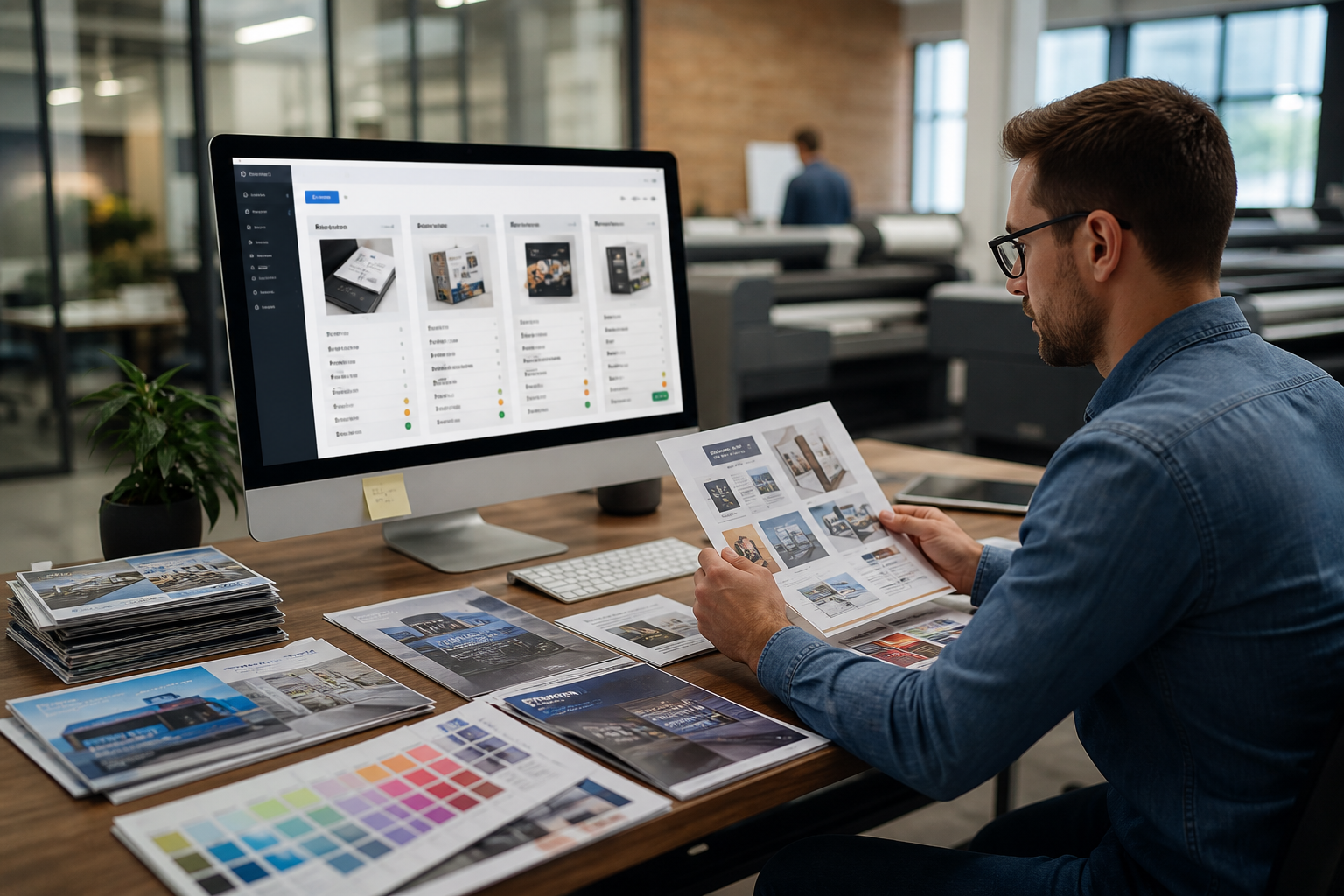
Designer-To-Printer Direct: Why Agencies Should Skip Fiverr And 99designs For Production
Tired of losing margin and quality control to design marketplaces? Here's how direct designer-to-printer connections protect your print jobs and your profit.

You've found a freelance designer on Fiverr, paid the platform's cut, then watched as the artwork lands in your prepress queue with RGB images, missing bleed, and a hairline Pantone you can't match on digital. Sound familiar? The gap between design marketplaces and actual print production is where margin, time, and goodwill quietly bleed away.
The Hidden Cost Of Design Marketplaces For Print Work
Fiverr, 99designs, Upwork and the like are brilliant for logos, social tiles and one-off creative. They are not built for print. The platforms cluster around designers who price for screen deliverables, not for printers who need press-ready PDFs with the right ICC profile, trim marks, and 3mm bleed. The result is a three-way game of telephone: client briefs a designer, designer delivers files, printer rejects or reworks them, and someone — usually the printer — eats the cost.
Then there's the commission stack. Design marketplaces typically take 20% from the designer and add a service fee on top of the buyer. By the time a job reaches your press, two middlemen have already taken a slice of a budget that was meant to cover paper, plates and makeready.
What Actually Goes Wrong
Speak to any prepress operator and you'll hear the same list:
- RGB artwork supplied for a CMYK process
- Images placed at 72dpi instead of 300dpi
- No bleed, or bleed but no crop marks
- Spot colours built as process, or vice versa
- Fonts not outlined, missing weights, or licensing issues
- Flattened PDFs with no editable layers for last-minute tweaks
- GSM and stock assumptions that don't match the quote
Each of these costs 15–45 minutes of prepress labour. Multiply by a week of jobs sourced through generic design platforms and you're funding a full-time fixer.
Why Direct Designer-To-Printer Connections Win
When a designer talks directly to the printer who'll run the job, the brief gets sharper before a single pixel is placed. The designer learns the press's sweet spot — maybe it's an HP Indigo 12000 that handles uncoated stocks beautifully but needs special handling on metallics, or a Komori H-UV line that needs trapping built a certain way. The printer learns the creative intent and can suggest finishing options — soft-touch lamination, spot UV, foil — that elevate the piece without blowing the budget.
That conversation simply doesn't happen on Fiverr. It can't: the platform is designed to keep buyer and seller inside its messaging walls and discourage off-platform contact.
The Conversations That Save Jobs
Direct access lets you have the short, specific chats that prevent reprints:
- "Can your Mimaki hit this exact Pantone on vinyl, or should we shift to a process build?"
- "If we drop from 350gsm to 300gsm uncoated, what does that do to the schedule and the feel?"
- "We've got a tight registration on the reverse — can prepress check the trapping before plates go down?"
- "The client wants a dummy by Thursday. Can you run an unprinted folded sample tomorrow?"
- "Is your wide-format queue open Friday for a last-minute pull-up banner?"
None of those questions fit a marketplace ticket system. All of them belong in a five-minute call between the people actually doing the work.
How ZeozGig Fits Into A Print Agency's Workflow
This is where ZeozGig was built for our world. Post an RFQ describing the job — say, 5,000 A5 flyers, 4/4 CMYK on 150gsm silk, gloss laminated, delivered to two London addresses — for $1. Trade printers and digital shops respond directly. If nobody bites, your fee is refunded automatically. When you find a printer worth a longer conversation, opening a direct connection is a one-time $5 fee, and a voice call to thrash out finishing details is 50 cents. A video call to walk through a proof? $1.
Compare that to a marketplace skimming 20% of every job, every time. On a £4,000 run, that's £800 going to a platform rather than into your margin or your client's pocket.
Building A Stable Of Print-Literate Designers
The same model works in reverse. If you're a printer who'd love a steady flow of work from designers who actually understand press-ready files, list yourself in the marketplace for $1 and describe your kit, your house stocks, and the file specs you want. Designers and agencies searching for a litho house with a five-colour Heidelberg, or a packaging printer with structural design support, can reach you directly. No commission on the job. No platform sitting in the middle of the relationship you've worked to build.
Over time, those direct connections become your network. The platform's role shrinks to introduction and connection — not a permanent tax on every transaction.
Keep The Margin Where It Belongs
Design marketplaces aren't going anywhere, and for some jobs they're genuinely useful. But when print is involved — with all its physical constraints, finishing options, and tight tolerances — the right model is a direct line between the person designing the piece and the person running it through the press.
Ready to cut the middleman out of your next print job? Post an RFQ on ZeozGig for $1, or list your press capacity and let designers come to you. Keep 100% of what you earn — and keep the conversation where it belongs: between you and the people who'll actually deliver the work.