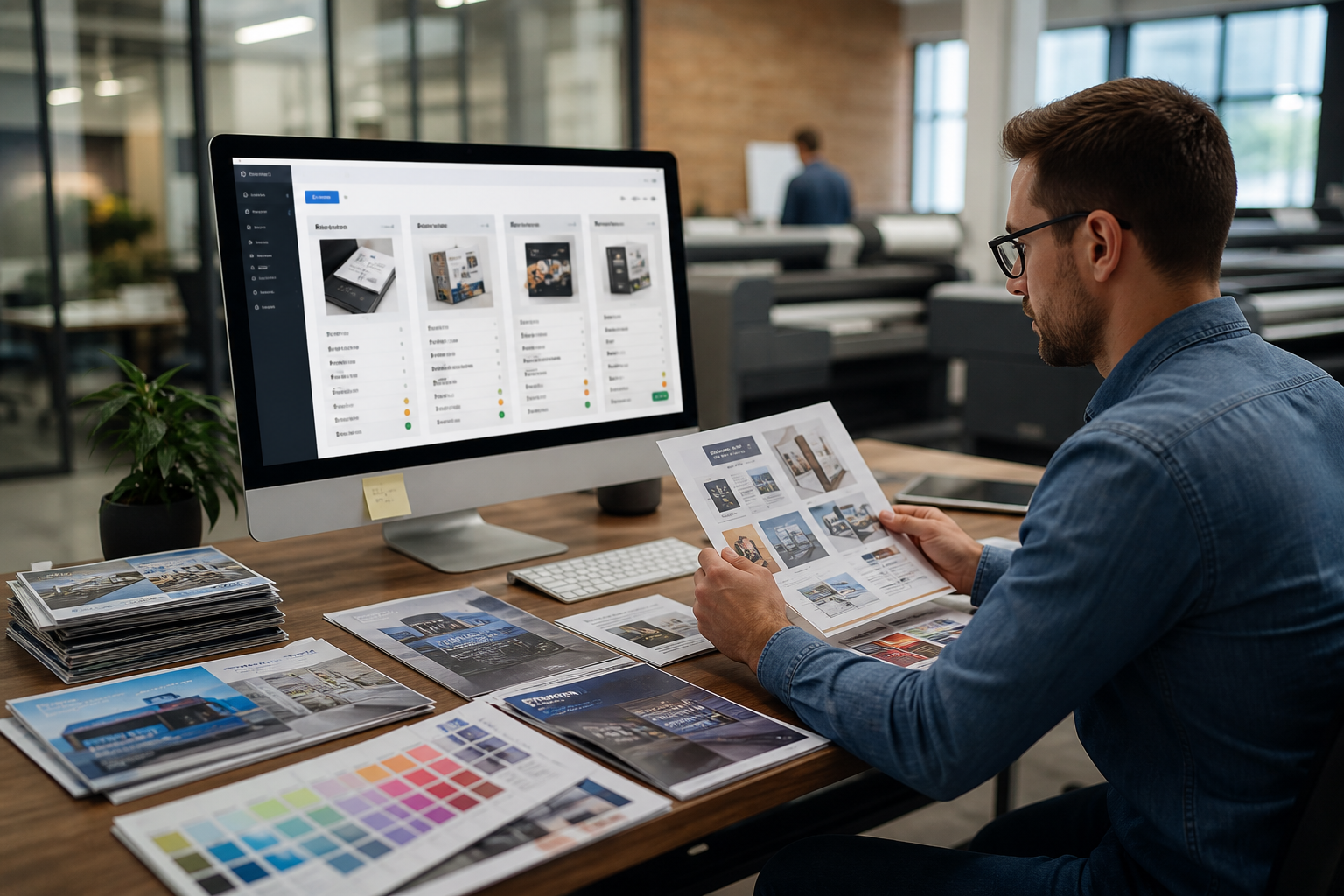
Why In-House Designers Should Book Print Production Direct, Not Through Creative Marketplaces
In-house designers are quietly routing print production through Fiverr and 99designs — and paying for it. Here's how direct printer connections change the maths.
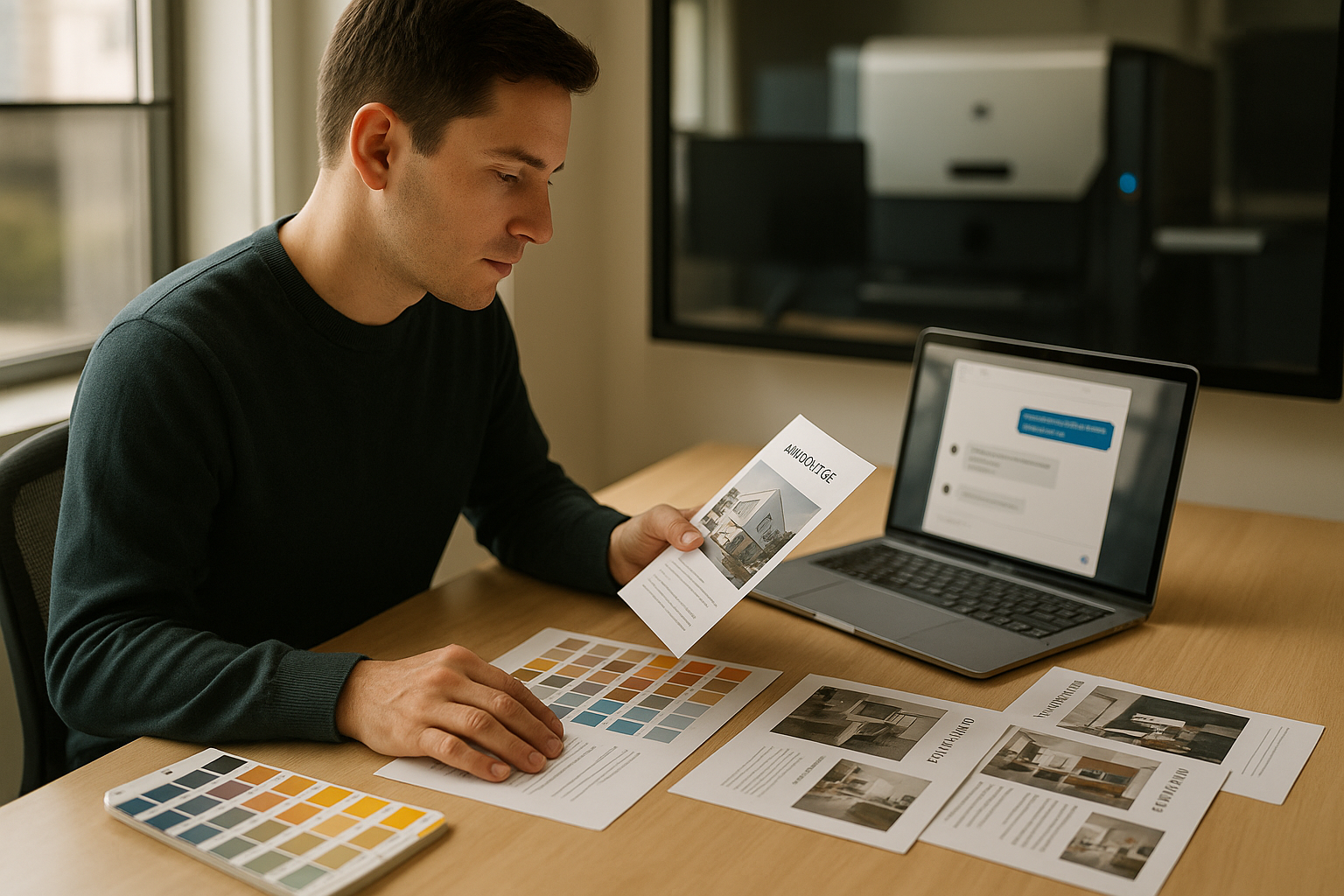
You're an in-house designer at a marketing team or agency. The artwork is signed off, the deadline is tomorrow, and you need 500 saddle-stitched brochures on 170gsm silk with a soft-touch laminate — quickly. So you do what everyone else does: you go back to that Fiverr seller who "knows a printer", or you punch it into a creative marketplace and hope the reseller doesn't fumble the bleed.
There's a better route, and most designers only discover it after a job goes sideways.
The hidden middleman in your print workflow
When you brief a print job through Fiverr, 99designs, Upwork or a generic creative marketplace, you're rarely talking to a printer. You're talking to a broker who is talking to a printer — sometimes two brokers deep. Each layer marks the job up, adds a day, and dilutes your specification.
By the time your PDF hits an actual press, the trail looks something like this:
- You brief the marketplace freelancer.
- They forward your PDF to a print broker.
- The broker sends it to a trade printer.
- The trade printer flags a bleed issue and emails the broker.
- The broker emails the freelancer.
- The freelancer messages you.
Six hops for what should be a two-minute conversation between the person who made the artwork and the person running the makeready. That's not just annoying — it's where jobs get quietly ruined.
Where commissions eat into your budget
Creative marketplaces don't publish exactly what they take, but the effective margin between what you pay and what the trade printer receives is typically 20–40% once the freelancer's fee, platform commission, and broker mark-up are stacked. On a £2,000 print run, that's £400–£800 that never touches ink, paper or finishing.
For freelance design work, fine — the freelancer is doing the design. But when the deliverable is production, you're paying a creative platform's commission on a manufacturing job. That maths has never made sense.
What a direct designer-to-printer conversation actually looks like
When you speak to a trade printer directly, the conversation is fundamentally different. You can:
- Ask whether 170gsm silk is really the best match, or whether 150gsm uncoated will feel more premium for the brand.
- Get a straight answer on whether Pantone 2945 C can be hit on their HP Indigo, or whether it needs a litho run with a spot ink.
- Confirm trim marks, bleed, and overprint settings before the file goes to plate.
- Negotiate a small tweak — say, a 4pp cover instead of self-cover — that saves £150.
- Book a video call to walk through a proof.
None of that happens through a marketplace ticket queue. It happens because two people who understand print are talking to each other.
The specifications you can finally control
Direct access to the printer means you get to specify — and question — things that marketplace briefs typically flatten:
- Substrate weight, finish and brand (e.g. GF Smith Colorplan vs. a house stock)
- Coating options: matt, gloss, soft-touch, silk, spot UV
- Finishing: perfect bind vs. PUR, foil block colour, deboss depth
- Ink coverage and Pantone matching tolerances
- Delivery format: bulk-packed, kitted, or drop-shipped to multiple sites
How ZeozGig fits into a designer's workflow
ZeozGig is a zero-commission B2B marketplace built originally by the team behind Print MIS software, so it speaks fluent print. Designers post an RFQ describing the job — stock, quantity, finishing, delivery deadline — and trade printers respond with quotes. If you want to talk to a specific printer directly, you open a connection for a flat $5 fee and chat, call or video with them straight away.
What's different from creative marketplaces:
- No commission on the job itself. The £2,000 print run stays a £2,000 print run.
- Fixed, tiny fees: $1 to post an RFQ, $1 to list a product, $5 to open a direct connection, $0.50 voice / $1 video.
- Refund on zero responses. If your RFQ gets no quotes, the $1 comes back.
- You talk to the actual printer, not a reseller wearing a headset.
Because there's no monthly subscription and no percentage cut, printers can quote at their real trade rate — which is usually where the savings for you come from.
When it's still worth using a creative marketplace
To be fair: if you genuinely need a freelance illustrator, a logo concept, or someone to knock up social assets, Fiverr and 99designs are fine tools. The point isn't that they're bad — it's that they were built for creative deliverables, not for manufacturing. Using them as a production channel is like using a taxi app to move house.
A simple test for your next job
Before you route your next print order through a creative marketplace, ask yourself three questions:
- Is the deliverable design work, or is it a physical printed product?
- Would I benefit from talking to the person who's actually running the press?
- Am I comfortable with 20–40% of my budget going to intermediaries?
If the answer to any of those is uncomfortable, it's probably time to try a direct route.
Ready to skip the middle layer?
Post your next print RFQ on ZeozGig for $1 and let trade printers quote directly. If no one responds, you get your dollar back. If someone does, open a connection for a flat $5 and talk to them properly — no commission, no contracts, no marketplace taking a slice of your production budget. Your artwork deserves a direct line to the press.