How to Lock Printer Pricing Before You Commit and Quote Clients With Confidence
Learn how to secure firm printer pricing before you quote your client, so your margin holds, your deadlines stick and your quote is watertight.
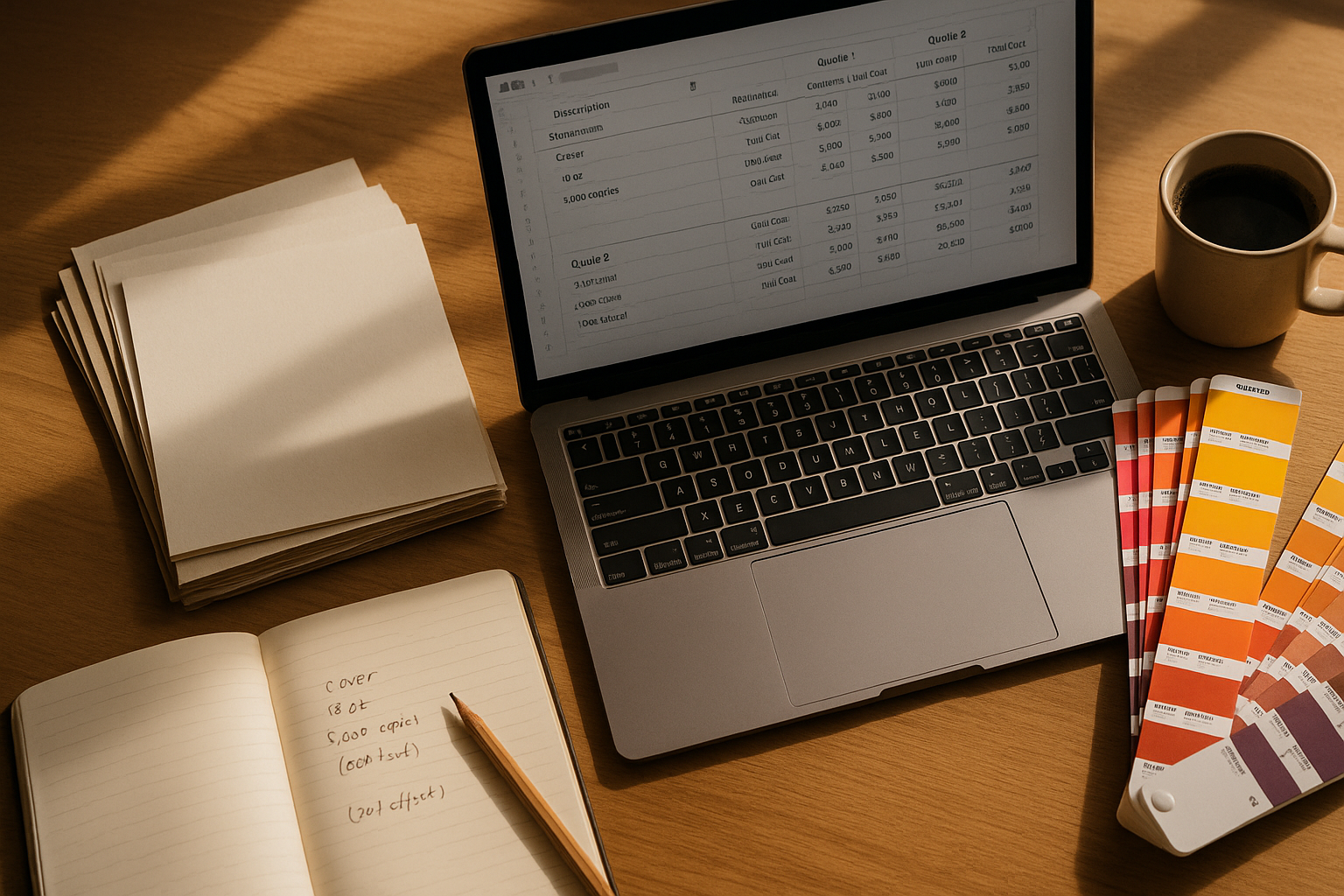
You've got a client waiting on a number, a job spec that isn't quite standard, and no way of knowing whether the price you're about to send will hold up once the printer sees the artwork. That gap — between quoting the client and confirming with the printer — is where margins vanish and reputations get bruised.
Why Quoting Before You've Locked Pricing Is a Silent Risk
Most print buyers, whether they're a broker, a marketing agency producer or a sole trader running an event, do the same thing: they estimate. They look at what a similar job cost last time, add a bit for the unusual stock or extra finishing, and send the client a figure. Then they go hunting for a printer who can actually hit that price.
The problem is obvious once you say it out loud. You've committed to a number before the people doing the work have committed to you. If the litho house you usually use is booked, if the GSM you assumed is out of stock, if the Pantone special needs a wash-up you didn't budget for — the price moves and your margin absorbs it. Or worse, you go back to the client and renegotiate, which is never a good look.
The three places pricing slips
- Stock and substrate: paper prices move, and unusual weights or coated stocks carry premiums that generic estimators miss.
- Finishing: foiling, die-cutting, embossing and specialist binding are where quotes balloon, especially on short runs where makeready dominates.
- Turnaround: a standard 7–10 day lead time is one price. A 48-hour turnaround with a Saturday delivery is quite another.
Lock the Printer Price First, Then Quote the Client
The fix is simple in principle and awkward in practice: get firm trade pricing in hand before you send your client a number. The awkward bit has always been time. Phoning three or four printers, emailing specs, chasing responses and comparing like-for-like quotes can eat half a day — and by the time you've done it, your client has moved on to someone quicker.
This is exactly the workflow a good B2B print marketplace collapses. Post one RFQ with your full spec — quantity, size, stock, GSM, CMYK or Pantone build, finishing, bleed, delivery point, deadline — and let multiple trade printers respond with firm numbers. You compare them side by side, pick the one that fits, and only then build your client quote on top of a confirmed cost.
What a lockable RFQ actually looks like
If you want printers to give you numbers they'll honour, you need to give them numbers they can trust. A tight RFQ usually includes:
- Exact quantities — plus one or two run-on options so you can flex the client quote.
- Trim size and finished format, including any folds or panels.
- Stock spec: weight, finish, brand if it matters (Silk, Uncoated, Recycled, etc.).
- Colour build: 4/4 CMYK, 4/0, plus any Pantones, and whether they must be spot or can convert.
- Finishing: lamination, foiling, spot UV, die-cut, perfect bound, saddle-stitched, wire-o — whatever applies.
- Delivery address and deadline, including whether it's one drop or split.
- Artwork status — print-ready PDF with bleed, or still in design.
The more specific the brief, the firmer the quote. Vague RFQs get vague numbers, and vague numbers move.
Why This Matters Whether You're a Broker or a One-Off Buyer
For a print broker or print management company, locked pricing is margin protection. You know your cost, you set your mark-up, you quote your client, and the maths doesn't shift under you. No mid-job phone calls to explain why the invoice is 12% higher than the estimate.
For an individual buyer — a startup founder printing pitch decks, an event organiser doing signage and lanyards, an artist commissioning a short-run zine — the same principle protects you differently. You're not managing margin, you're managing budget. Locking a printer price before you say yes means you know what the job actually costs before you commit personal money to it.
A quick example
Say you need 2,500 A5 flyers, 350gsm silk, 4/4 CMYK with a soft-touch lamination and spot UV on one side. Ask three printers by phone and you might get three wildly different numbers depending on who's got press time and who's guessing at finishing. Post it as an RFQ to a marketplace of trade printers, and within hours you've got firm quotes with clear lead times. Pick one, and your cost is set before your client ever sees your figure.
The Small Cost of Certainty
The reason buyers historically didn't do this on every job is that phoning round is expensive in time, and web-to-print aggregators bake commission into every price they show you. On ZeozGig, posting an RFQ costs a pound, and if no supplier responds, that pound comes back. Opening a direct connection with the printer you pick is a fixed five-pound fee — one-off, not a percentage of the job. There's no commission on the deal, no monthly subscription, and no middleman between you and the press.
That means you can lock pricing on every job, not just the big ones. Small runs, one-offs, unusual finishing, region-specific delivery — all worth an RFQ, because the downside of posting one is negligible and the upside is a firm number you can quote against.
Ready to Quote With Confidence?
Stop estimating and hoping. Post your next print RFQ on ZeozGig, get firm quotes from trade printers who actually want the work, and lock your cost before you send your client a single number. If you're a printer or finisher, list your capacity on the marketplace and let buyers with real, specced-up jobs come to you — no commission on the work you win, ever.